
The Real Cost of Deferred Roof Maintenance
Florida Certified Roofing Contractor and Certified General Contractor
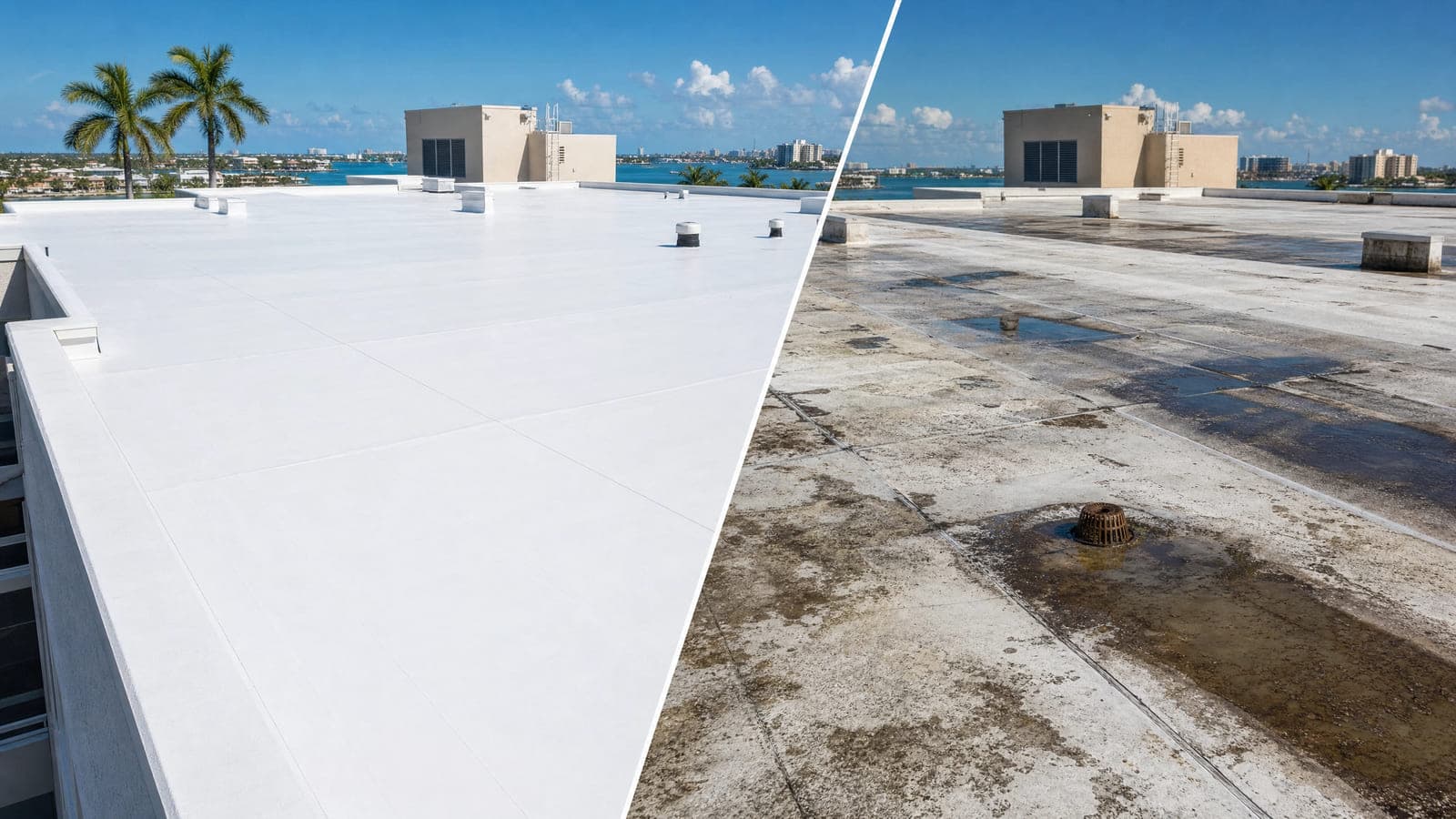
Deferring roof maintenance does not save an association money. It moves the money — forward in time, into a larger number, and usually into a form owners like far less than a line item on the annual budget. That is the whole argument of this article, and the rest of it is the arithmetic behind the claim.
The difficulty for a board is that the savings from deferral are visible and immediate while the costs are delayed and diffuse. Not funding a maintenance program is a decision you can point to in this year's budget. The consequences arrive as a shortened service life, a larger repair scope, and a reserve contribution that has to climb — none of which announce themselves as the result of a vote taken four years earlier. What follows is a way to make both sides of that trade visible at the same time, using only figures published elsewhere on this site so you can check the inputs.
What does deferring roof maintenance actually cost?
Deferred maintenance costs an association through three separate channels, and boards usually only account for the first one. The first is repair scope — the same defect costs more to fix later than sooner. The second is service life — an unmaintained roof reaches replacement earlier, which compresses the years available to save for it. The third is documentation position — no maintenance record means weaker footing with a warranty manufacturer, an insurance underwriter, and a reserve analyst.
The first channel is the one people picture, and it is the smallest of the three. The second is where the real money is, because roof replacement is the largest single capital item most Florida communities own, and moving its date forward changes every number downstream of it.
How does a small repair become a large one?
A small repair becomes a large one because water does not stay where it enters. On a low-slope roof, the great majority of leaks start at details and transitions — drains, penetrations, seams, and flashings — rather than in the open field of the membrane. A failed pipe boot or an open lap is, on the day it fails, a sealant-and-patch repair on a scheduled visit.
Left alone through a wet season, that same opening lets water into the insulation beneath the membrane. Insulation is absorbent and continuous, so the water travels laterally, well beyond the entry point, and it does not dry out. What was a detail repair is now a section tear-off: remove the membrane over the affected area, replace saturated insulation, inspect and possibly replace deck, then rebuild the assembly. Interior finishes in the units below may be involved by then as well.
The physical mechanism is why timing dominates cost here, and it is the practical case for the twice-yearly rhythm described in how often a commercial roof should be inspected in Florida. The National Roofing Contractors Association's long-standing guidance is built on the same observation: routine inspection exists to find failures while they are still small.
What does deferral do to a roof's service life?
Deferral shortens the modeled service life of a roof, and our own planning tool quantifies that assumption explicitly. The Roof Reserve Calculator on this site applies a maintenance-history factor to a roof's base service life: a documented semi-annual program multiplies modeled life by 1.1, occasional repairs only by 1.0, and no maintenance history by 0.9. Coastal exposure applies a second factor — 0.95 within roughly five miles of the coast.
That is a planning assumption, not a measurement of your building. It is the assumption the calculator uses, stated openly so a board can argue with it. Applied to a TPO roof — a single-ply plastic membrane, the white reflective surface common on newer flat buildings — with a 22-year base life within five miles of the coast, the three maintenance histories model out as roughly 23, 21, and 19 years respectively. The distance between the best and worst case is about four years.
What do four years of service life cost in dollars?
Four years of lost service life costs an association about $2,750 a year on the illustrative roof below. The figures here are an illustration built from the ranges published on this site, not a case study, a measured result, or a project Egret has completed.
Take a 40,000 square foot TPO roof within five miles of the coast. The roof replacement page publishes TPO at roughly $5 to $10 per square foot installed, with a $7.50 midpoint. That puts replacement at $200,000 to $400,000, or $300,000 at the midpoint.
| Maintenance history | Modeled service life | Replacement at midpoint | Annual reserve, straight line |
|---|---|---|---|
| Documented semi-annual program | ~23 years | $300,000 | ~$13,000 |
| Occasional repairs only | ~21 years | $300,000 | ~$14,300 |
| None or unknown | ~19 years | $300,000 | ~$15,800 |
Two honest caveats. These figures spread today's replacement cost evenly across the full modeled life, which is simpler than the calculator itself — the calculator works from remaining life and adds 3 percent construction inflation, so real planning numbers run higher. And the replacement cost is identical in all three rows, which is the point: maintenance does not make a roof cheaper to replace. It changes how many years you have to pay for it.
Now compare the other side of the ledger. Published program pricing for mid-rise flat roofs is $0.04 to $0.08 per square foot per year, which on 40,000 square feet is $1,600 to $3,200 annually. The reserve difference between a documented history and no history — about $2,750 a year — sits inside that same range. On this illustration the maintenance program roughly funds itself through the reserve line alone, before counting a single avoided repair, warranty claim, or interior loss. Your own roof will produce different numbers; the Roof Reserve Calculator will run them in a couple of minutes.
What happens when replacement arrives early?
When replacement arrives early, the shortfall becomes a special assessment, and for condominiums Florida law has narrowed the board's room to postpone it. A condominium building three or more stories in height must complete a Structural Integrity Reserve Study (SIRS) at least every ten years under Florida Statute 718.112, and the roof is the first item the study must address.
The funding consequence is the part boards should register. Under that statute, members of a unit-owner-controlled association required to obtain a SIRS may not determine to provide no reserves, or less reserves than required, for the listed items. Reserve funding for the roof is no longer something owners can vote away in a hard budget year. A shortened remaining useful life therefore translates directly into a higher mandatory contribution. Our guide to SIRS, milestone inspections, and your roof covers that framework in detail.
Homeowners' associations sit under a different chapter and a different rule. Reserves under Florida Statute 720.303(6) are established only on the affirmative approval of a majority of the total voting interests and can be waived the same way. The legal exposure is lower; the financial exposure to owners is unchanged. An unfunded roof still has to be paid for, and it arrives as an assessment rather than as contributions owners had years to make.
Deferred condition also surfaces on a schedule the board does not control. Condominium and cooperative buildings three stories or more must undergo a milestone structural inspection at 30 years under Florida Statute 553.899, and a local enforcement agency may require it at 25 years where local conditions such as proximity to salt water warrant. Roof deficiencies documented in that process become a matter of record.
Does deferral affect insurance and code position?
Deferred maintenance weakens an association's documentation position in two specific, concrete ways. The first is evidentiary. Florida Statute 627.70132 requires notice of a new or reopened property insurance claim within one year of the date of loss, and a supplemental claim within 18 months. Meeting a deadline is not the same as proving what happened, and the association that cannot show the roof's condition before the storm is arguing about wear and tear from a weaker position. Carriers underwrite on roof age and condition, and a documented file is what lets a board answer those questions directly — that is a readiness point, not a promise about premiums or coverage outcomes.
The second is scope and code. Florida Statute 553.844(5) provides that where an existing roofing system or roof section was built, repaired, or replaced in compliance with the 2007 Florida Building Code or a later edition, and 25 percent or more of it is repaired, replaced, or recovered, only the worked portion must be constructed to the Florida Building Code then in effect. Where the existing system does not meet that condition, the exception does not apply. Letting damage accumulate until a large share of a roof section needs work is therefore a decision with code consequences that depend on the vintage of what is already up there — a question for your contractor and the local building department before anything is bid.
The board-level takeaway
Deferring roof maintenance is a financing decision disguised as a savings decision. The association is not avoiding the cost of the roof; it is borrowing against the roof's remaining life at an interest rate nobody quotes, and repaying it later as a compressed reserve contribution or a special assessment.
The version of this argument a board can actually use is not "maintenance is good." It is a comparison of two numbers your own community can generate: what an annual program costs, and what your reserve contribution becomes if the roof's remaining life shortens by a few years. Put both in front of the board in the same meeting, with the roof's system, install year, and square footage written down, and the decision stops being a matter of judgment about diligence and becomes a matter of arithmetic.
Frequently Asked Questions
- Is it cheaper to skip maintenance and just replace the roof when it fails?
- No, because skipping maintenance does not change what a replacement costs — it only makes the replacement arrive sooner. A roof that reaches the end of its service life four years early forces the association to accumulate the same replacement dollars over four fewer years, which raises the annual contribution rather than lowering it. The maintenance spending is also small relative to the replacement it defers, and it is the spending that produces the condition record a reserve analyst, an insurer, and a manufacturer will each ask for.
- How much does deferred roof maintenance actually cost an association?
- There is no single figure, because it depends on roof size, system, and how long the deferral runs. The honest way to size it for your own community is to compare two numbers: what a maintenance program costs annually, and how much your annual reserve contribution rises if the roof's remaining useful life shortens. On the illustrative 40,000 square foot TPO roof in this article, built entirely from the ranges published on this site, those two numbers land in the same neighborhood — which means the program roughly pays for itself in reserve terms before a single avoided repair is counted.
- Our roof is not leaking. Why spend money on maintenance now?
- Because most roof failures develop for months or years before water reaches a ceiling, and the cheap window to fix them closes well before the leak appears. A failed pipe boot or an open seam is a sealant repair while it is still just a failed detail. Once water has entered the insulation below, it spreads sideways through the assembly, and the repair becomes a section tear-off with wet insulation and possibly deck to replace.
- Can our condominium association vote to skip roof reserves to save money this year?
- Not if the association is required to obtain a Structural Integrity Reserve Study. Florida Statute 718.112 provides that the members of a unit-owner-controlled association that must obtain a SIRS may not determine to provide no reserves, or less reserves than required, for the items the study covers — and the roof is the first listed item. Homeowners' associations are governed by a different chapter, and reserves under Florida Statute 720.303(6) remain optional, established or waived by a majority of the total voting interests.
- Does deferred maintenance affect a manufacturer's roof warranty?
- It can. Many commercial roofing warranties, and nearly all No Dollar Limit warranties, condition coverage on the roof being kept clean, drained, and maintained, with repairs performed by qualified contractors. When a claim is filed the manufacturer commonly asks for the maintenance history, so a board that can produce dated inspection reports is in a stronger position than one that cannot. The specific conditions are set by your warranty document, so read the one you actually hold.
- If we repair more than 25 percent of our roof, do we have to replace the whole thing?
- Not necessarily, and the answer turns on the vintage of the existing system. Florida Statute 553.844(5) provides that if an existing roofing system or roof section was built, repaired, or replaced in compliance with the 2007 Florida Building Code or any subsequent edition, and 25 percent or more of it is being repaired, replaced, or recovered, only the repaired, replaced, or recovered portion must be constructed to the Florida Building Code in effect. Where that condition is not met the exception does not apply, so the scope question belongs with your roofing contractor and the local building department before the work is bid.
- How do we put a real number on our own roof instead of an illustration?
- Start with three facts about each roof: the system, the year it was installed, and the area in square feet. Those three inputs, plus coastal exposure and maintenance history, are enough to produce a planning-grade estimate of remaining useful life, replacement cost, and an annual reserve figure. That estimate is a budgeting starting point, not a bid or a reserve study — a dated professional condition report is what turns it into something a reserve analyst can rely on.
How Egret Roofing Can Help
Egret Roofing is a licensed Florida commercial roofing contractor serving condominium and HOA communities across Northeast Florida. Our Roof Asset Management Program puts a two-visit annual calendar, a dated photo baseline, and a board-ready Roof Condition Report behind your community’s roof, so the documentation an insurer, reserve analyst, or milestone inspector will ask for already exists when they ask.
If your board is weighing scheduled maintenance, a repair, a full replacement, or planning around condo and HOA obligations, a short, no-pressure conversation about where your roof stands is a reasonable next step.
Sources
- Florida Statute 718.112 — Condominium bylaws; Structural Integrity Reserve Study and reserve funding
- Florida Statute 720.303 — Homeowners' association powers and duties; budgets and reserves
- Florida Statute 553.844 — Windstorm loss mitigation; roof repair and code compliance
- Florida Statute 553.899 — Mandatory structural inspections for condominium and cooperative buildings
- Florida Statute 627.70132 — Notice of property insurance claim; deadlines
- National Roofing Contractors Association — Roofing guidelines and technical resources