
Who Pays for Townhome Roof Repairs in Florida: HOA or Owner?
Florida Certified Roofing Contractor and Certified General Contractor
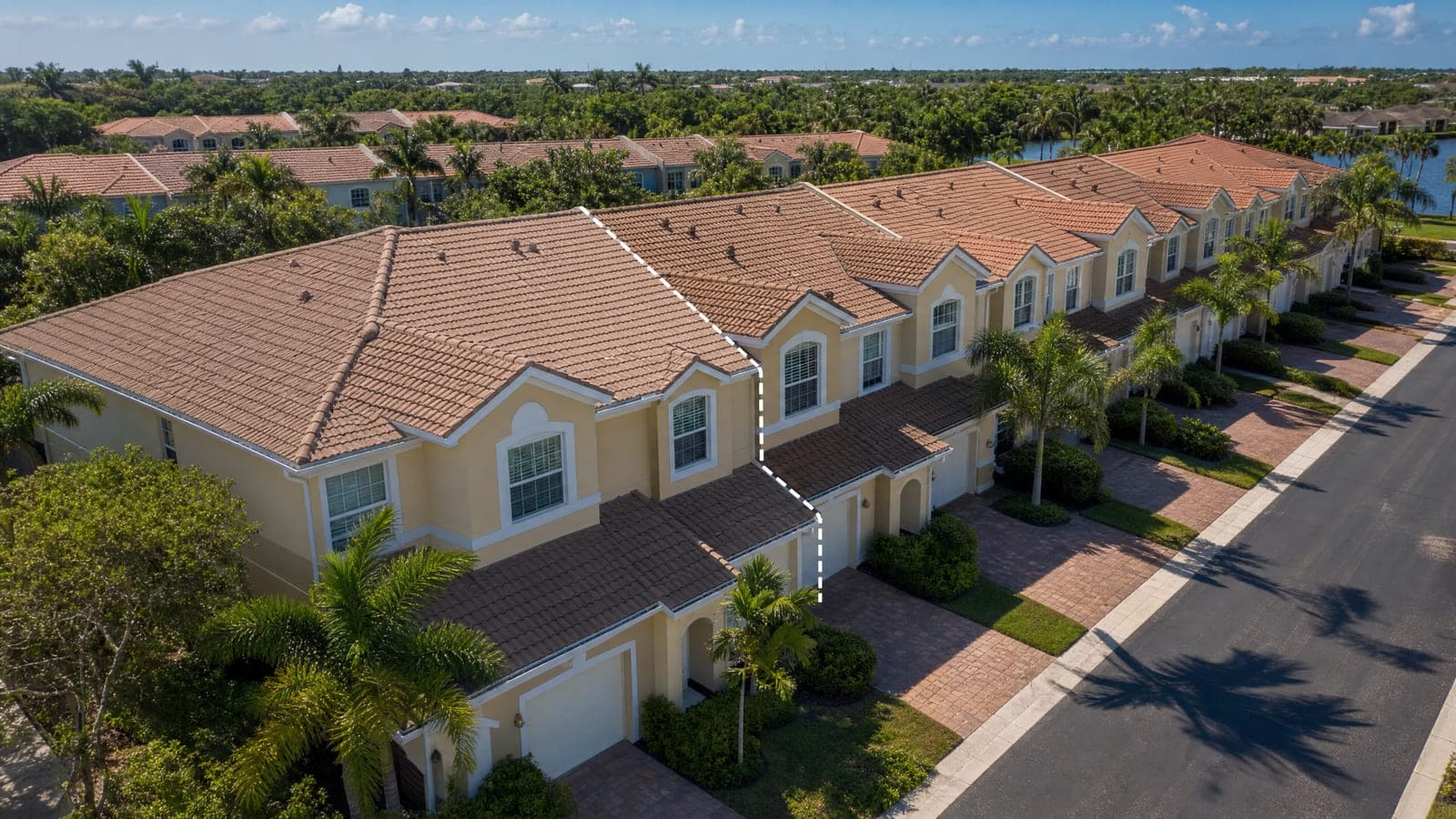
A townhome owner finds a water stain on the bedroom ceiling and calls the property manager. The manager says the roof belongs to the association. A board member says it does not. Both of them are certain, and in a Florida homeowners' association both of them can be right — in different communities, on the same street, under documents that look almost identical from the outside.
This article explains why that happens, what actually decides the question, and how a board or an owner finds the answer in their own paperwork. It also covers the part boards ask about second: if the association does own the roofs, how a portfolio of townhome roofs gets funded before it fails. Everything here is general information about how Florida law allocates these obligations, not legal advice for your community.
Who pays for a townhome roof repair in Florida?
In a Florida homeowners' association, the recorded declaration decides who pays for a townhome roof repair — there is no statewide default that puts the roof on the association. Chapter 720 of the Florida Statutes, which governs homeowners' associations, does not assign roof maintenance the way the condominium chapter does. It leaves the allocation to what the statute calls the governing documents: the recorded declaration of covenants and its amendments, plus the association's articles of incorporation and bylaws.
In practice, Florida townhome and villa declarations tend to fall into three patterns:
- Association maintains the roofs. The declaration lists roof maintenance, repair, and replacement among the association's obligations, and the cost is funded through assessments and, where they exist, reserves. This is common in townhome communities that were developed with a shared exterior-maintenance model.
- Owner maintains the roof. The declaration leaves the structure on the parcel — including the roof — with the owner, and the association maintains only the common areas. Repairs are the owner's expense and usually subject to architectural review for materials and color.
- A split. The association maintains the roof covering while the owner is responsible for the deck, the structure below it, or interior damage. This is the pattern that produces the most disputes, because the boundary between "covering" and "structure" is not obvious to anyone standing in a bedroom looking at a stain.
None of these is more correct than the others. What matters is which one your recorded documents describe.
Why is a condominium different?
A condominium is different because the statute answers the question directly instead of deferring to the documents. Florida Statute 718.113 provides that maintenance of the common elements is the responsibility of the association, except for limited common elements the declaration assigns to a unit owner. The roof over a condominium building is almost always a common element, so the condominium association maintains, repairs, and replaces it.
The reason for the different treatment is the underlying ownership structure. A condominium owner owns an interior unit — essentially the airspace and finishes inside a shared building — together with an undivided share of everything else. There is no sensible way to give an individual unit owner the roof, because the roof sits over many units at once.
A homeowners' association owner owns a parcel: the lot and the structure standing on it. Even when townhomes share party walls, each owner holds real property that includes their own building envelope. Because the owner already owns the structure, assigning roof maintenance to the association is a choice the developer made in the declaration rather than a consequence of the ownership form. Florida Statute 720.301 defines the parcel and the common area along exactly these lines, and it is why Chapter 720 stays quiet where Chapter 718 speaks.
One consequence worth flagging: a community can call itself a "condominium" in marketing and be an HOA in law, or the reverse. Villa communities in Northeast Florida are especially mixed. The recorded documents, not the sign at the entrance, determine which chapter applies.
Where should a board look for the answer?
A board should read four things, in this order, and the answer usually appears in the first one.
- The maintenance article of the recorded declaration. This is where the obligation is assigned. Look for the list of components the association agrees to maintain, repair, and replace, and the matching list left to owners. Roofs are normally named explicitly in one of the two.
- The insurance article. If the association is obligated to insure the buildings themselves rather than only the common areas, it almost always maintains their roofs as well. The two obligations are usually drafted to travel together.
- The budget and reserve schedule. An existing roof line item in the reserve schedule is strong practical evidence of how the community has always read its own documents, and courts and owners both notice long-standing practice.
- The recorded amendments. Declarations get amended, sometimes specifically to move roofs from one column to the other. Confirm you are reading the current recorded version rather than the developer's original.
If those four agree, the board has its answer and should record it in the minutes so the next board is not relitigating it in three years. If they disagree, the association's attorney resolves it. A roofing contractor cannot, and one who volunteers an opinion on your covenants is doing your board no favors.
Do Florida HOAs have to fund reserves for roofs?
No — HOA reserves are optional in a way condominium reserves no longer are, and this is the second big difference boards should understand. Under Florida Statute 720.303(6), a homeowners' association is deemed to have provided for reserve accounts only upon the affirmative approval of a majority of the total voting interests, and reserves established that way can be waived or terminated by the same kind of vote. An association that has not established statutory reserves must carry a conspicuous statement in its financial report saying the budget does not provide for fully funded reserve accounts and that special assessments may result.
Condominiums moved in the opposite direction. Buildings three or more habitable stories tall must complete a Structural Integrity Reserve Study (SIRS) under Florida Statute 718.112, and under the 2025 legislation owners can no longer vote to waive or reduce reserve funding for the listed structural components — the roof among them. Our guide to SIRS, milestone inspections, and your roof covers that framework in detail.
The practical translation for an HOA board is uncomfortable but simple. The legal exposure is lower; the financial exposure to owners is identical. An unfunded roof portfolio still has to be paid for when it fails, and the bill arrives as a special assessment rather than as contributions owners had years to make. Voting reserves down does not make roofs last longer.
How should an HOA plan for a portfolio of shingle roofs?
An HOA that maintains its members' roofs should plan them as a portfolio on a phased schedule, because townhome buildings were almost always roofed in the same year and will reach the end of their service life in the same window. This is the structural difference between HOA roofing and condominium roofing, and it is where most budget surprises come from.
A condominium board typically faces one large flat roof with one replacement date. An HOA board faces twenty or thirty small pitched shingle roofs that all turn twenty-five years old at once. Treating that as "a few roofs a year, eventually" understates it badly, because there is no natural stagger — the stagger has to be created deliberately.
The workable approach has four steps:
- Establish condition per building. Grade each roof and estimate its remaining useful life individually. Exposure varies across a community; the buildings on the windward edge or under heavy tree cover age faster than the ones in the middle.
- Group the buildings into phases. Three to five phases is typical. Sequence them by condition and exposure rather than by street address, so the roofs failing first get replaced first.
- Price a phase and inflate it. Take today's installed cost for one phase and project it forward to the year that phase is due. Construction inflation is real and compounds over a ten-year plan.
- Set the annual contribution. Divide each phase's projected cost by the years until it is due. The sum across phases is the annual roof reserve contribution — a number the board can defend to owners because every input is visible.
Maintenance economics differ too. A townhome portfolio is priced per building rather than per square foot, because the labor scales with the number of separate roofs to access and walk, not with total area. Thirty small roofs cost meaningfully more to service than one roof of the same combined area, and per-building mobilization — staging, protection, cleanup — repeats every time. A proposal that prices a townhome portfolio on a flat-roof square-foot basis is usually underscoped.
Extending the life of the roofs already in place is the cheapest lever a board has. Keeping a portfolio on twice-yearly inspection and maintenance pushes the replacement phases further out, and the documented condition record supports a longer remaining-life estimate when a reserve analyst prices the plan.
What should an owner do when a townhome roof leaks?
An owner who finds a leak should report it to the association in writing the same day, whoever turns out to be responsible for the repair. Written notice does two things: it starts the association's clock if the roof is theirs, and it establishes that the owner acted promptly if it is not. Photograph the damage with the date visible, and keep the water off the ceiling if you safely can — every property owner has a duty to take reasonable steps to prevent further damage after a loss.
Then let the documents sort out the invoice. Interior damage and the roof repair itself are separate questions, and they are often answered by different parties and different policies. Because the answer depends on the specific declaration and the specific policies in force, that part belongs with the association's attorney and the insurance agents involved.
The board-level takeaway
For a Florida HOA board, the question "who pays for the roof" is not a roofing question at all — it is a documents question, and it has a definite answer sitting in the recorded declaration. Read the maintenance article, confirm it against the insurance article and the reserve schedule, write the conclusion into the minutes, and stop rediscovering it every time a ceiling stains.
If the answer is that the association owns the roofs, the second question follows immediately: are they documented well enough to plan around? A portfolio with dated condition reports and per-building remaining-life estimates can be phased, funded, and defended to owners. A portfolio without them gets a conservative guess from a reserve analyst and a special assessment from reality. Our condo and HOA roofing page explains how we build that record, and the Roof Reserve Calculator will put a first number on it in a couple of minutes.
Frequently Asked Questions
- Does the HOA or the homeowner pay for roof repairs in Florida?
- It depends on the recorded declaration, because Chapter 720 of the Florida Statutes sets no statewide default for roofs in a homeowners' association. Some townhome and villa declarations put roof maintenance, repair, and replacement squarely on the association; others leave it entirely with the owner of the parcel; many split it, giving the association the roof covering while the owner keeps the interior and any structure below the deck. The governing documents control, and they vary community by community.
- Why is a condominium different from an HOA on this question?
- Because the two are built on different ownership structures and different statutes. A condominium owner owns an interior unit inside a shared building, and Florida Statute 718.113 makes maintenance of the common elements — which almost always include the roof — the association's responsibility. An HOA owner owns a parcel, meaning the lot and the structure standing on it, and Chapter 720 leaves maintenance obligations to the governing documents rather than assigning them by statute.
- Where exactly in our documents should we look?
- Look at the maintenance article of the recorded declaration of covenants first, since that is where the obligation is assigned. Then read the insurance article, because an association obligated to insure the buildings themselves usually maintains their roofs as well; check whether the budget or reserve schedule already carries a roof line item, which shows how the community has read its own documents in practice; and confirm you are reading the current recorded version including all amendments, not the developer's original.
- What happens if the declaration is silent or ambiguous about roofs?
- That becomes a legal question for the association's attorney rather than a roofing question. Boards sometimes resolve genuine ambiguity by amending the declaration to state the allocation clearly going forward, which requires the owner approval percentage the documents specify. What a board should not do is settle an ambiguity informally at a meeting and start spending shared money on that basis, because an owner can challenge the practice later.
- Do Florida HOAs have to fund reserves for roof replacement?
- No. Under Florida Statute 720.303(6) an HOA is deemed to have provided for reserve accounts only on the affirmative approval of a majority of the total voting interests, and those reserves can be waived or terminated the same way. An association without statutory reserves must include a conspicuous statement in its financial report that the budget does not provide for fully funded reserve accounts and that special assessments may result.
- Who pays when a roof leak damages the inside of a townhome?
- The roof repair and the interior damage are two separate questions, and the declaration plus the two insurance policies involved usually answer them differently. Even where the association maintains the roof covering, an owner's policy commonly responds to interior finishes and personal property. Because coverage turns on the specific policies and the declaration, this is a question for the association's attorney and the insurance agents involved, not for a roofing contractor.
- Does the association's roofing contractor decide who pays?
- No, and a contractor who offers an opinion on it is exceeding what it can know. A roofer's job is to establish what the roof needs, document its condition, and price the work accurately. Which budget the invoice lands in is set by the governing documents and, where those are unclear, by the association's attorney.
How Egret Roofing Can Help
Egret Roofing is a licensed Florida commercial roofing contractor serving condominium and HOA communities across Northeast Florida. Our Roof Asset Management Program puts a two-visit annual calendar, a dated photo baseline, and a board-ready Roof Condition Report behind your community’s roof, so the documentation an insurer, reserve analyst, or milestone inspector will ask for already exists when they ask.
If your board is weighing scheduled maintenance, a repair, a full replacement, or planning around condo and HOA obligations, a short, no-pressure conversation about where your roof stands is a reasonable next step.
Sources
- Florida Statute 720.301 — Homeowners' associations: definitions (parcel, common area, governing documents)
- Florida Statute 720.303 — Association powers and duties; budgets and reserves
- Florida Statute 718.113 — Condominium maintenance of the common elements
- Florida Statute 718.112 — Condominium bylaws (Structural Integrity Reserve Study requirement)
- Florida Senate — CS/HB 913 (2025) condominium and cooperative associations
- Florida DBPR — Division of Condominiums, Timeshares, and Mobile Homes